
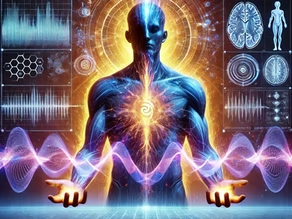
The Metaphysics of Massage Therapy
Massage therapy is often understood through a physical lens, focused on tension in muscle tissue, circulation, structural imbalance, and recovery from strain. That view is accurate but incomplete. Beneath the mechanical layer there is a deeper interaction between the body, perception, and internal state. The metaphysics of massage therapy does not discard physiology, it extends it. It treats the body not only as a structure to be worked on, but as a system that experiences, adapts, and stores information across multiple levels of awareness.
When someone receives structured massage work aimed at full body regulation and tension release, the outcome is not limited to softer muscles. Breathing shifts, mental noise often decreases, and the way the body is felt from the inside changes. These shifts can be measured through nervous system response and are experienced subjectively as calm, clarity, or release. The meeting point between physical input and internal experience is where the metaphysical dimension of massage begins.
The Body as an Experiential System
The human body does not function as a set of isolated parts. Muscle, fascia, nervous system activity, and perception operate as one system. Tension is not only a mechanical event. It is influenced by stress patterns, emotional conditioning, and repeated behavioral responses. Over time these influences become embedded in posture, movement, and baseline muscle tone. The body starts to maintain patterns that are no longer consciously chosen but automatically held.
Massage therapy introduces a controlled external input that interrupts these patterns. Pressure, movement, and sustained contact provide the nervous system with new information. That information allows the system to reassess whether a given level of tension is necessary. In many cases the body registers that it is not and release follows. The process is physical, but the experience of that release is internal and is often described as letting go, opening, or resetting. Those descriptions are the subjective side of physiological change.
Energy as Functional Experience
The word energy is often used in ways that sound abstract, which can make it difficult to work with. In practical terms it can be understood as how the body feels and responds from the inside. Areas of restriction feel dense, tight, or resistant. Areas that are more balanced feel open, mobile, and responsive. These different qualities correspond to measurable changes in circulation, nerve signaling, and tissue elasticity. The language of energy is one way of describing these differences from the internal perspective rather than from external instruments.
Massage therapy affects this internal experience directly. As pressure is applied and tissue begins to change, sensations shift. People frequently report warmth, pulsing, tingling, or a sense of movement within the body. These are consistent with changes in how the nervous system is processing incoming signals. The metaphysical perspective does not run against physiology. It points to the same process described through lived experience rather than only through technical terms.
The Role of Awareness
Awareness is one of the most overlooked aspects of massage therapy. Many people move through daily life with limited awareness of their own bodies. Tension rises slowly over time and eventually feels normal. It drops out of conscious notice even as it influences posture and mood. Massage brings these areas back into awareness. As a practitioner works through different regions, the client begins to feel places that had gone quiet in attention.
This awareness is not a passive byproduct. It is a critical part of the release process. When awareness increases, the nervous system becomes more flexible. The body is better able to distinguish between tension that is useful for support and tension that is left over from past states. This allows for more efficient regulation and can reduce the tendency for chronic holding patterns to return at the same intensity. In this way, massage becomes not only a method of relief but a method of retraining perception.
Stored Patterns and Release
The body carries patterns that are built through repeated experience. Physical workload, emotional strain, and habitual movement all contribute to these patterns. Over time they become embedded in muscle tone, connective tissue, and reflexive responses. The person may not be consciously aware of them, but they influence how the body moves and how it reacts under stress.
Massage therapy can disrupt these patterns by applying consistent and targeted pressure over time. As tissue responds and changes, the nervous system receives new feedback that supports the release of previously maintained tension. In some cases this process is accompanied by emotional responses. The work is not aiming at emotions directly, but as the body lets go of patterns tied to earlier experiences, emotional content can surface and resolve. The release is physical in action but the experience of it often extends beyond the mechanical.
Intention and Direction
The way massage is applied influences how effective it will be. A structured and intentional approach tends to produce different outcomes than a purely routine based session. Intention in this context is not vague or mystical. It is the direction of focus and the quality of attention the practitioner brings to the work. Pressure is applied with awareness of tissue response, movement patterns, and areas of restriction rather than in a random or automatic way.
The client’s role also matters. When attention is directed toward the body during treatment instead of drifting elsewhere, results often improve. Breathing becomes steadier, resistance decreases, and the nervous system becomes more receptive. The interaction between practitioner input and client awareness creates a more effective therapeutic environment. The process becomes a shared engagement rather than something happening to a passive recipient.
Presence and Nervous System Regulation
Massage therapy has a direct impact on the nervous system. It tends to support a shift away from constant fight or flight activation toward a more regulated baseline. This shift is reflected in slower and more even breathing, reduced muscular guarding, and a greater sense of internal stability. Presence is an important part of that shift. When both practitioner and client are present with the work, the system can organize itself more efficiently.
Distraction pulls energy away from this process. Focused presence supports it. This matches what is known about sensory processing. Focused attention improves the ability of the brain and body to interpret and respond to input. In the context of massage therapy, that means deeper relaxation, more complete release, and results that tend to last longer between sessions.
Integration of Physical and Internal Experience
The apparent divide between physical and metaphysical becomes less firm when examined closely. Much of what is called metaphysical in this context is simply the internal side of physical processes. The body does not separate structure from perception in its own operation. It functions as one integrated system. Massage engages that system as a whole.
This is why the effects of a session often extend beyond immediate relief of a tight muscle. People commonly report clearer thinking, reduced stress, and a greater sense of balance after treatment. These are not unrelated add ons. They are part of the same shift that occurs when the system is less burdened by unnecessary tension and is communicating more clearly within itself.
Conclusion
The metaphysics of massage therapy is not an attempt to move away from reality. It is a way of naming the fact that physical intervention always has an internal dimension. Touch changes tissue, but it also changes perception, awareness, and regulation. When these elements are addressed together, massage therapy becomes more than a method for easing discomfort. It becomes a structured approach to altering how the body organizes itself and how it is experienced from within. The depth of the work lies at that intersection between physical input and internal transformation.
If you want to explore more articles that connect massage, energy, and metaphysical perspectives on healing, you can find them in the energy healing and metaphysics articles hub.
Explore related articles on energy healing and metaphysical wellness: