
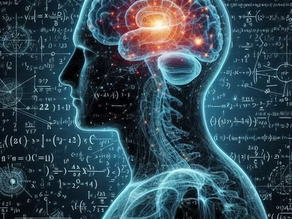
What Is the Mind Body Bridge
A full exploration of the mind body connection would cross many fields, from neuroscience and psychology to philosophy and traditional healing systems. The idea of a mind body bridge invites close attention to how thoughts, emotions, and conscious awareness relate to the physical organism. It is not a new concept, but it has become more visible as people question the limits of purely reductionist medicine and look for ways to understand how subjective experience shapes health. The mind body bridge is one way of naming the territory where inner life and physical processes meet.
Instead of treating the mind as one domain and the body as another, this perspective asks how information moves between them and how patterns in one can alter patterns in the other. That shift in viewpoint has consequences for how we think about illness, resilience, and what it means to work with the whole person rather than with isolated parts.
Communication Between Mind and Body
For a long time, much of Western thought treated mind and body as fundamentally separate. Classical dualism, associated with figures such as René Descartes, framed the mind as a non physical realm of thinking and the body as a mechanical, extended thing. In that model, the mind was given priority as the seat of identity, while the body was viewed as a kind of complex machine that the mind drives.
As ideas and evidence have evolved, that sharp divide has become harder to maintain. Modern approaches tend to see mind and body as two aspects of a single system, exchanging signals continuously. The mind is not something floating above the body. It arises with and through the body and its processes, even if it cannot be fully reduced to them.
Scientific Exploration of the Mind Body Connection
Recent science has given more detailed ways to talk about this connection. In neuroscience, the concept of neuroplasticity shows that the brain can reorganize itself throughout life. Patterns of thought and emotion are not only effects of brain activity, they also feed back into the structure and function of neural networks. Learning, practice, and experience can strengthen or weaken connections, alter how regions communicate, and change how signals are processed.
This means that mental habits, emotional states, and ways of paying attention can shift physical patterns in the brain and, by extension, in the rest of the body. The mind body bridge is visible here as a loop rather than a one way line. Mental activity influences physical structure, and physical structure constrains and supports mental activity.
Psychoneuroimmunology
The field of psychoneuroimmunology examines how psychological states, the nervous system, and the immune system interact. Research has shown that ongoing stress and unresolved emotional strain can weaken immune responses and increase vulnerability to illness. Chronic activation of stress pathways is linked with cardiovascular strain, digestive disturbances, and autoimmune patterns.
On the other side, positive emotional states, social connection, and a sense of meaning are associated with better immune markers and more robust health outcomes. These findings underscore that the immune system is not isolated. It responds to signals from the brain and from subjective experience. Again, the mind body bridge appears as a network of loops in which emotional and cognitive processes have bodily consequences.
Mental Health and Physical Health
Conditions such as anxiety, depression, and post traumatic stress show vividly how closely mental and physical dimensions are linked. People dealing with these difficulties often report headaches, muscle tension, digestive issues, fatigue, and pain alongside emotional distress. These are not separate problems piled on top of each other. They are different expressions of the same underlying patterns working through one system.
Conversely, living with long term physical illness or persistent pain commonly affects mood, sleep, motivation, and outlook. The mental and emotional burden of managing symptoms can lead to feelings of hopelessness or fear. This two way influence makes it clear that approaches which address only the body or only the mind leave part of the picture out.
Cultural Perspectives
Many traditions have long treated mind, body, and spirit as inseparable. In a number of Indigenous and traditional frameworks, health is a balance among these dimensions and with the environment. Disturbances in relationship, environment, or spiritual life are seen as inseparable from physical symptoms. Practices such as meditation, movement arts, and ritual are used to restore balance across all levels at once.
These approaches do not draw sharp lines between psychological and physical processes. Instead they assume that anything that affects one will ripple through the others. This assumption aligns with what science is now documenting in different terms.
Eastern Approaches to the Mind Body Connection
Systems such as Buddhism, Taoism, and traditional Chinese medicine place strong emphasis on internal balance and the flow of vital energy. Concepts like qi or prana describe a subtle aspect of life that moves through the body and is linked with both physical and emotional states. When this flow is disrupted or constrained, problems can emerge across the spectrum from mood to organ function.
Practices including acupuncture, acupressure, qigong, and related methods aim to restore smooth circulation of this energy and improve the coordination between mind and body. Whether one adopts the exact language of these systems or not, they reflect an underlying recognition that internal states and bodily patterns are tightly bound together.
Western Approaches to the Mind Body Connection
In recent decades, Western practice has begun to incorporate more explicit mind body methods. Mindfulness and related contemplative techniques have moved from monasteries into clinics, workplaces, and everyday life. These practices revolve around paying steady, non judgmental attention to present moment experience, including sensations, thoughts, and feelings.
Research suggests that such practices can reduce stress, improve emotional regulation, alter brain activity, and support physical health measures such as blood pressure and immune function. In this sense they operate directly on the mind body bridge by changing how experience is met and processed.
Somatic Therapy
Somatic psychology offers another route into this territory. It emphasizes that emotional and psychological experiences are not only represented in thoughts but also held in the body. Trauma and long running stress can show up as chronic tension, altered posture, and patterns of movement that reflect protective or defensive responses.
Somatic therapies involve working through the body with breath, movement, and carefully applied touch to help release these stored patterns. The idea is that engaging the body directly can shift emotional states and reorganize internal narratives, again making use of the bidirectional nature of the mind body bridge.
Growing Interest in the Mind Body Connection
The broader wellness movement has helped bring mind body ideas into everyday awareness. Practices like yoga, Pilates, and other mindful movement disciplines integrate strength, flexibility, and breath with attention and mental focus. They encourage people to tune into internal signals, notice where tension is held, and build a more coherent sense of self that includes both physical and mental aspects.
People who engage in such practices often report not only physical benefits but also mental clarity, emotional steadiness, and a greater capacity to handle stress. These effects illustrate how deliberately working with the body can change internal experience and vice versa.
Quantifying the Connection
Even with growing evidence, fully mapping the mechanisms of the mind body connection remains difficult. Objective tools such as imaging, hormone assays, and heart rate variability provide valuable data, but subjective experience cannot be reduced to numbers without loss. Mental states are lived from the inside, and that interior dimension is part of what any adequate account must address.
This tension between measurable processes and lived experience is itself part of the mind body problem. It raises questions about what counts as explanation and how far physical description can go in capturing the reality of consciousness and feeling.
The Future of Medicine
Recognition of the mind body bridge has significant implications for healthcare. It suggests that treating symptoms in isolation from emotional and psychological context is likely to miss important factors. More integrated approaches that consider stress, trauma, relationships, and meaning alongside physical findings may improve outcomes and reduce suffering.
Models that bring mental health care, body based therapies, and medical treatment into closer collaboration move in this direction. Preventive strategies that address lifestyle, stress patterns, and ways of relating to experience recognize that health is not merely the absence of disease but the presence of flexible, resilient mind body functioning.
Conclusion
The mind body bridge is a way of naming the deep interconnection between mental and physical life. As scientific research, philosophical reflection, and traditional wisdom continue to intersect, that interconnection becomes harder to ignore. The evidence points toward a picture in which mind and body are aspects of one process rather than separate substances.
Honoring this reality opens the door to forms of care that are more precise and more humane. By working with both mental patterns and bodily states, it becomes possible to support change that is more stable and more complete. For many people, this means seeking out approaches that explicitly address both sides of the bridge rather than focusing on one while neglecting the other.
If you are interested in working with the mind body connection through both structured touch and energy work, you can learn more about integrated Reiki massage sessions at my practice.
Explore related articles on energy healing and metaphysical wellness: