
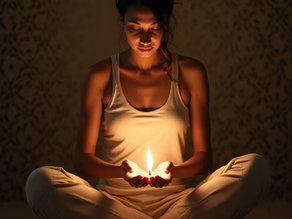
Distance Reiki Healing and How It Works Without Physical Contact
Distance reiki healing is often described as the ability to direct focused intention and awareness toward another person without physical contact. It is typically discussed within the broader context of energy-based practices, where attention, perception, and internal state are considered influential factors in how the body responds to stress. People searching for distance reiki are usually not approaching it as an abstract idea. They are looking for a way to understand why their body remains tense, fatigued, or mentally overloaded even when external demands are reduced. These patterns are closely tied to nervous system behavior, particularly the inability to shift out of a constant state of alertness. Distance reiki is framed as a method that may influence this state indirectly by creating conditions where the body can begin to settle. The emphasis is not on force or manipulation, but on how internal processes respond when the system is given consistent signals associated with safety and regulation.
What Distance Reiki Healing Actually Refers To
Distance reiki is not a separate discipline from traditional reiki, but rather an application of the same underlying principles without physical touch. In both cases, the practitioner works with structured attention and intention, but in distance work the interaction occurs without proximity. The concept is built around the idea that the body’s regulatory systems are influenced by more than direct mechanical input. Mental focus, expectation, and environmental cues all play a role in how the nervous system organizes itself. When those factors shift, the body may respond by reducing unnecessary tension and improving its ability to recover. The language used to describe this often varies, but the functional perspective remains consistent. It is less about transmitting something tangible and more about influencing the conditions under which the body operates.
How Distance Reiki Healing Is Believed to Work
One of the most common questions surrounding distance reiki is how it can have any effect without physical interaction. From a practical standpoint, the explanation centers on the relationship between attention, perception, and physiological response. During a session, the practitioner maintains a focused awareness while the recipient is typically in a resting or receptive state. This combination can create a shift in the recipient’s internal environment, particularly if they are able to disengage from external stressors. The body may begin to show signs of reduced activation, such as slower breathing, decreased muscle tension, and a quieter mental state. These responses are associated with parasympathetic activity, which governs rest and recovery. Over time, repeated exposure to this type of input may help the body recognize and return to these states more easily.
Why People Search for Distance Reiki Healing
Search patterns around distance reiki reflect a consistent theme of individuals looking for relief from ongoing stress and imbalance. Many are dealing with chronic tension, disrupted sleep, or persistent mental fatigue that does not resolve through rest alone. Others are exploring options because they cannot access in-person care due to time, location, or physical limitations. The appeal of distance reiki is largely based on accessibility and the idea that support can be received without logistical barriers. However, the underlying motivation is almost always the same. The body is not settling, and the individual is looking for a way to restore some level of internal balance. This makes the topic relevant even for those who ultimately choose a different form of care.
What a Distance Reiki Session Feels Like
Reports of distance reiki sessions tend to follow similar patterns, even though the experience itself is subjective. Individuals often describe a gradual reduction in mental activity, a sense of heaviness or grounding in the body, and a noticeable decrease in tension. These responses are consistent with a shift toward parasympathetic dominance. There is no physical pressure applied, and no direct manipulation of tissue. Instead, the body appears to respond to a consistent and non-threatening input. Emotional responses can occur, but they are usually brief and not the central focus of the session. The primary outcome is a change in internal state rather than a specific physical sensation. This distinction is important because it reflects a systemic adjustment rather than a localized effect.
The Nervous System and Regulation
Understanding distance reiki becomes more practical when viewed through the lens of nervous system regulation. The body is constantly balancing between states of activation and recovery. When activation becomes prolonged, the system can lose its ability to return to baseline. This results in persistent muscle tension, shallow breathing, and increased mental load. Practices that support regulation aim to reintroduce conditions where the body can safely reduce this activation. Distance reiki is often discussed in this context because of its focus on consistent, low-intensity input. Rather than forcing change, it allows the system to adjust gradually. This approach tends to produce slower but more stable results, particularly for individuals dealing with long-term stress patterns.
Distance Reiki Compared to In-Person Reiki
The primary difference between distance reiki and in-person reiki is the presence of physical contact. In-person sessions include hands-on techniques that directly influence muscle tissue, fascia, and circulation. This provides an additional layer of input that can accelerate certain responses. Distance reiki, by contrast, relies entirely on internal perception and response. While both approaches aim to support regulation, the pathways are different. In many cases, individuals exploring distance reiki eventually seek out in-person work to experience a more direct and measurable form of change. This progression reflects a practical understanding of how different methods can complement each other rather than compete.
Limitations and Skepticism
Distance reiki is frequently met with skepticism due to the lack of consistent empirical evidence and the subjective nature of reported outcomes. This skepticism is valid and highlights the importance of maintaining realistic expectations. The practice should not be viewed as a replacement for medical care or as a guaranteed solution for complex conditions. Instead, it can be understood as one of many approaches that aim to influence how the body responds to stress. For some individuals, the concept itself provides a useful framework for understanding their experience. For others, the value lies in exploring methods that support regulation, regardless of how they are labeled.
Long-Term Patterns and Adaptation
Any approach focused on regulation, including distance reiki, depends on consistency rather than intensity. A single session may produce a temporary shift, but lasting change requires repeated exposure. Over time, the nervous system can become more efficient at entering a regulated state, reducing the effort required to achieve it. This process is similar to other forms of training, where repetition leads to adaptation. The key difference is that the focus is on internal state rather than external performance. For individuals dealing with persistent tension or stress, this type of gradual adaptation can be more sustainable than short-term interventions.
Understanding the Role of Direct Experience
While distance reiki is often discussed as a concept, the question of effectiveness ultimately comes down to experience. Many individuals find that understanding the idea intellectually does not produce meaningful change on its own. The body responds most clearly to direct input, particularly when that input includes physical cues such as pressure, movement, and contact. This is where in-person work becomes relevant. It provides a level of feedback that is difficult to replicate in a non-contact setting. For those exploring distance reiki, this often leads to a broader consideration of how different approaches influence the body in different ways.
Reiki Energy Healing in Olympia, WA
For individuals exploring the concepts behind distance reiki but looking for a more direct and measurable approach, reiki energy healing sessions in Olympia, WA provide a structured, in-person setting where the same principles of regulation and balance can be applied with physical awareness. The focus remains on helping the body shift out of persistent tension patterns, but with the added benefit of direct sensory input that supports clearer and more consistent responses.