What Is the Third Eye?
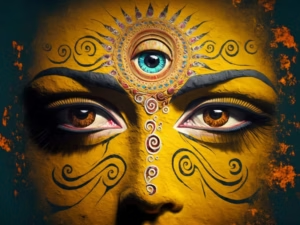
The third eye is a way of talking about perception that goes beyond the five senses and ordinary thought. It is usually placed symbolically in the center of the forehead, associated with the ajna chakra, and treated as the seat of intuition and inner vision. When people speak about “opening” the third eye, they are pointing to a shift in how clearly you can see through your own stories, habits, and conditioning. It is less about seeing ghosts and more about seeing your life without the usual fog.
Across traditions, the third eye is the point where individual awareness is said to meet something larger. You can call that larger field spirit, consciousness, pattern, or simply the deep structure of reality. The details of the map change, but the claim is the same: when this inner eye is functioning, you are less trapped in surface appearances and more able to sense what is actually going on beneath them.
Symbolism and Background
In classical Indian systems the third eye is linked to the ajna chakra, the sixth major energy center. Ajna is often translated as “command” or “perception,” which gives you a sense of how it functions in the model. It is where impressions are integrated, where you form a picture of the world, and where you direct your attention. When this center is dull, your view narrows. When it is clear, your field of view widens.
Similar images show up outside of India as well. The eye of Horus in Egyptian iconography, certain depictions of light or flame at the forehead in Christian and Sufi art, and images of radiant foreheads in Buddhist contexts all circle around the same idea: an awakened capacity to see the invisible structure behind visible experience. Whether or not those cultures meant the exact same thing, the recurring symbol tells you that humans have been wrestling with this layer of perception for a long time.
Modern occult and New Age scenes have piled extra mythology onto the concept, some of it helpful and some of it pure distraction. Stripped of hype, the third eye remains a workable shorthand for your ability to notice patterns, sense subtle cues, track the consequences of choices, and recognize when your own mind is distorting what you see.
How the Third Eye Functions in Practice
In the chakra model, the third eye sits between the more concrete centers (survival, sexuality, will, emotion) and the more expansive crown. It gathers input from the lower chakras and shapes it into meaning. That shows up in ways that are not dramatic but are very practical: recognizing when your anxiety is about now versus a past imprint, sensing when someone’s words do not match their actual intent, or feeling that a path is wrong even when it looks reasonable on paper.
Functionally, you can think of it as the part of you that steps back and looks at the whole field. It is not purely intellectual. It integrates sensations, gut feelings, memories, and impressions into a picture that is bigger than any one data point. When people say “something in me knew,” they are describing this layer whether they use that language or not.
When the third eye is ignored or numbed, you tend to live on reflex. You chase every distraction, believe every thought, and take every image at face value. When it is over‑emphasized without grounding, you can drift into fantasy, paranoia, or spiritual escapism. The useful range is in between: perception that is sharp and flexible, tied back to the body and to ordinary life.
Working With the Third Eye
If you strip away the mystique, the main tools for working with the third eye are straightforward: quiet attention, steady breathing, honest self‑observation, and practices that teach you to stay with subtle impressions without forcing them. You do not need elaborate rituals to begin. You need enough stillness to notice what is already happening in your own field.
Basic Focus Practice
A simple exercise is to sit comfortably and rest your attention in the area between the eyebrows and slightly above. You keep the rest of your body relaxed, breathing evenly through the nose. You are not trying to stare a hole through your forehead. You are letting that area be the anchor for your awareness, the same way the breath is an anchor in basic meditation.
As thoughts, images, and memories surface, you notice them and let them pass instead of jumping into each one. Over time, you may feel warmth, pulsing, or a sense of spaciousness behind the forehead. Whether or not those sensations show up, the core of the practice is the same: you are training yourself to stay present in the middle of inner activity without getting thrown by every wave.
Seeing Through, Not Around
Another way of working with the third eye is to deliberately question what you think you are seeing. When you feel a strong reaction to a person or situation, you ask what assumptions and projections are coloring your view. You notice where the story you are telling about an event does not match the raw facts. You look directly at your own motives, fears, and desires instead of pretending they are not there.
This is not as glamorous as talk about visions and psychic gifts, but it is where most people will get real leverage. The third eye in this sense is less about adding new content to your experience and more about cleaning up the distortions that already live there. Seeing through your own illusions is the foundation for any more esoteric work.
Signs and Side‑Effects of “Opening”
People who spend time with these practices report a range of changes. On the subtle end, there is often a gradual sharpening of intuition, a sense that you can “read” situations faster and more accurately. Dreams may become more vivid or coherent. Coincidences and meaningful patterns stand out more easily. You catch yourself before walking into familiar traps.
On the more disruptive side, bringing this layer online can stir up material you have been avoiding. Old beliefs, unresolved grief, and inconvenient truths about your relationships or choices can surface. The third eye is not a filter that only lets in pleasant light. It shows what is there. Some of that will be uncomfortable. That is not a bug in the process; it is part of why most traditions pair this work with grounding, ethics, and body‑based practice.
If you find yourself becoming jumpy, ungrounded, or obsessed with signs and omens, that is feedback that you are leaning too hard into this layer without enough support from the rest of the system. In that case, shifting focus back to simple embodiment—walking, breath, strength work, hands‑on therapies—will do more for your actual health than trying to force more “opening.”
Intuition Versus Fantasy
A central skill in third eye work is learning to distinguish between intuition and wishful thinking or fear. Intuition tends to be quick, quiet, and specific. It shows up as a simple “yes,” “no,” or “not now,” often before the mind has had time to build a narrative. Fantasy is bigger, louder, and more dramatic. It usually plays to your hopes or your fears and often contradicts itself over time.
One practical test is to track outcomes. When you act on a certain kind of inner signal, does it consistently lead toward more clarity, integrity, and workable results, even if it is uncomfortable? Or does it lead toward more confusion, drama, and avoidance? The third eye as a function of awareness is not fragile. It can stand up to this level of scrutiny. If a “message” collapses under honest review, you file it under imagination and move on.
Keeping a simple written record of impressions and what happens when you follow them can help cut through self‑deception. You stop giving equal weight to every inner flash and start to see which patterns are actually reliable. That is the opposite of blind belief; it is disciplined experimentation with your own perception.
Bringing Third Eye Work Into Daily Life
You do not have to separate this from the rest of your life to make use of it. In ordinary situations, third eye work looks like pausing before you react, noticing the whole field instead of fixating on one detail, and listening to the quiet part of you that already knows when something is off. It is what lets you sense that a conversation is about to turn, that a deal is wrong even though the numbers look good, or that a “small” choice carries a larger weight than you first thought.
In relationships, it shows up as seeing through roles and masks. You start to notice the patterns that play out between you and other people instead of just blaming or defending. In work, it can mean understanding the underlying dynamics of a team or system, not just the explicit tasks. In your own inner life, it means seeing how your thoughts and feelings arise and pass without treating each one as a command.
None of this requires you to announce that you are working with your third eye. It requires you to pay attention in a way that is deeper and more honest than the default. The language you use for that is secondary to the fact that you are doing it.
Used Well, Not Chased
The third eye is easy to romanticize and easy to misuse. Chasing visions and exotic experiences while ignoring your body, your boundaries, and your basic responsibilities is a reliable way to get lost. Using this layer of perception to become more precise, more honest, and more aligned in how you live is the opposite. It anchors the “mystical” into something that serves your actual life instead of distracting from it.
In a practical metaphysical or healing context, this capacity is what lets you read a client’s pattern without projecting your own story onto them, sense when to intervene and when to leave something alone, and stay oriented even when strong emotion is in the room. It is not about performing specialness; it is about seeing clearly enough to do less damage and more good.
If you are curious how work with perception, intuition, and subtle anatomy ties into hands‑on approaches to stress, pain, and recovery, you can explore the holistic healing and mind–body resource center for grounded examples.