What Are Body Meridians?
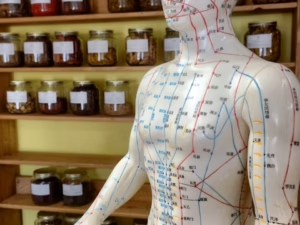
Over the centuries, the concept of body meridians has drawn the attention of healers and scholars across cultures. Meridians are described as subtle pathways through which vital energy, or qi, flows, influencing physical, emotional, and spiritual states. They are understood to connect organs and systems in a dynamic way that is shaped by lifestyle, environment, and internal patterns. Exploring meridians offers a framework for holistic healing and a deeper appreciation of how mind and body interact.
Key Takeaways
- Meridians are energy pathways that support the flow of qi and connect organs and functions throughout the body.
- Practices such as acupuncture, acupressure, qigong, and herbal medicine aim to optimize qi flow along meridians to address physical and emotional imbalance.
- Modern research is investigating possible physiological correlates of meridians, including electrical and circulatory changes along mapped pathways.
Understanding Body Meridians
For those new to the idea, meridians can be thought of as channels that organize and distribute vital energy within the body. In Traditional Chinese Medicine (TCM) and related holistic systems, these pathways are central to how qi moves, nourishes, and coordinates different regions and organs. Balanced movement of this energy is considered essential for maintaining health, while blockages or distortions in flow are associated with a range of physical and emotional symptoms.
Definition of Body Meridians
Meridians are not physical structures in the sense that arteries and nerves are. They are functional networks mapped through observation and clinical practice. Each meridian is associated with specific organs and physiological processes, forming an interconnected system that reflects the body as a whole rather than isolated parts. Working with these pathways allows practitioners to address underlying energetic patterns rather than only visible symptoms.
Historical Context in Traditional Chinese Medicine
Meridians have been part of Chinese medical theory for thousands of years. Early medical texts describe relationships between energy flow, organ function, and emotional states, laying the groundwork for the meridian model. Over time, observations from different periods and lineages refined these ideas, creating a detailed system that links specific channels with organs, seasons, elements, and emotional qualities.
This history positions meridians as a bridge between traditional insights and contemporary inquiry. They represent a way of understanding health that integrates body, emotion, and environment rather than separating them into unrelated categories.
The Role of Qi
Qi is sometimes described as an abstract idea, but within this framework it serves as the organizing life force that moves through the meridian system. It is understood as the energy that animates the body, underlies physiological processes, and influences emotional and mental experience. Practices that cultivate, balance, or redirect qi are aimed at restoring coherence across these levels.
Concept of Vital Energy
Qi is often described as an invisible yet functional principle that sustains living systems. Different cultures have named similar concepts, but in Chinese philosophy qi specifically links body, mind, and spirit. When qi is sufficient and flowing smoothly, functions are said to be clear and coordinated. When its movement is disrupted, patterns of discomfort, instability, or disease are more likely to appear.
Importance of Qi Flow for Health
Free circulation of qi within the meridians is considered a core condition for health. When qi moves without obstruction, it supports organ function, tissue nourishment, and emotional stability. When it becomes blocked, stagnant, or deficient, people may experience pain, fatigue, stress-related symptoms, and lowered resilience. Practices like acupuncture, acupressure, and qigong are designed to restore and harmonize this circulation.
Because lifestyle, emotional state, and environment all influence qi flow, practitioners often look beyond isolated symptoms. They consider sleep, diet, stress, and other factors as part of the same energetic picture and use that information to guide treatment and self-care recommendations.
Meridians and Organ Systems
In TCM, each meridian has defined links with particular organs and functional systems. Together, these channels form a network that coordinates internal processes and maintains balance. Health in this view is a state of dynamic harmony among organs, emotions, and external influences, all mediated through the flow of qi along meridians.
The system is flexible and responsive rather than fixed. Lifestyle patterns, emotional experiences, and seasonal changes all affect how qi moves through these pathways, which in turn can influence how well associated organs function.
Key Meridians and Associated Organs
Different meridians are associated with distinct roles. The Liver meridian, for example, is linked with the liver and gallbladder and is described as governing the smooth flow of qi and emotion. The Lung meridian is connected to respiratory function and defensive qi, with implications for immunity and boundary. The Kidney meridian is associated with growth, reproduction, and deep energy reserves.
When qi in a particular meridian is disrupted, corresponding organs and functions may reflect that imbalance. Practitioners use knowledge of these relationships to tailor treatments that address both local symptoms and their broader energetic context.
Emotional and Spiritual Connections
Meridians are also associated with emotional tendencies. For instance, the Heart meridian is linked with joy and connection, while the Liver meridian is associated with the processing of frustration and constraint. Stagnation or imbalance in a channel can show up as recurring emotional patterns as well as physical sensations.
Approaching meridians in this way allows for work that addresses emotional and spiritual well-being alongside physical concerns. Shifts in flow can correspond with changes in mood, perspective, and sense of integration, supporting a more complete approach to healing.
Dynamic Nature of Meridians
Qi flow through meridians is not static. It varies with stress levels, emotional state, movement, diet, environment, and other factors. Practitioners often consider these influences when assessing the system, because they can either support or disrupt balance over time.
- Stress and emotional load
- Diet and hydration
- Physical activity and rest
- Climate, season, and living environment
Changes in any of these areas can contribute to either ease or difficulty in qi circulation. Addressing them is part of a holistic strategy to support meridian health.
Seasonal and Environmental Impact
Each season is associated in TCM with particular organs, elements, and meridians. Spring is linked with the Liver, emphasizing movement and renewal. Winter is associated with the Kidneys, emphasizing rest, storage, and conservation. As seasons shift, so do the energetic demands placed on the body.
Environmental conditions such as temperature, light, and air quality also play a role. People may notice changes in energy, mood, or physical comfort with different weather patterns or urban stressors. Recognizing these influences allows for intentional adjustments in routine, diet, and practice to support smoother meridian function.
Healing Practices Involving Meridians
Many traditional therapies work explicitly with meridians to influence health. These methods aim to restore balance, relieve blockages, and strengthen overall flow rather than only suppress symptoms. They can be used preventively as well as in response to specific concerns.
Acupuncture and Acupressure
Acupuncture uses thin needles inserted at specific points along meridians to modulate qi. It is used for a wide range of complaints including pain, stress-related conditions, and functional imbalances. Acupressure applies manual pressure at similar points and is often used as a needle-free alternative or self-care technique.
Qigong and Herbal Medicine
Qigong combines movement, breath, and focused awareness to cultivate and balance qi internally. Movements are generally slow and deliberate, helping to open channels, strengthen reserves, and calm the mind. Herbal medicine is used alongside these practices to support organ function and address specific patterns identified through meridian-based diagnosis.
Together, movement practices and herbal support offer a way to participate actively in the care of the meridian system, aligning daily life more closely with the body’s energetic needs.
Scientific Perspectives
Modern science approaches meridians from a different starting point, but there is growing interest in their possible physiological basis. Some studies have reported differences in electrical conductivity, tissue properties, or blood flow along lines that resemble traditional meridian maps. These observations suggest that the mapped pathways may correspond to functional properties of the body, even if they do not match visible anatomical structures.
Research on Meridian Pathways
Imaging and biophysical studies have explored how stimulation of certain points influences local and systemic responses. Increased conductivity along particular paths and consistent effects on pain modulation and circulation have been reported in some research. These findings are preliminary but point toward measurable correlates of meridian-based interventions.
Correlation with Physiological Phenomena
Research on acupuncture has documented changes in brain activity, blood flow, and immune markers when specific points are stimulated. These changes often line up with traditional indications for those points and meridians. While the language and frameworks differ, this work suggests that meridian theory may describe patterns that have tangible physiological echoes.
Ongoing investigation is aimed at understanding how these traditional maps relate to nervous, circulatory, and connective tissue systems, and how that knowledge might be integrated into broader models of health.
Final Words
The idea of body meridians provides a framework for understanding how energy, function, and experience interrelate. In TCM, these channels guide the flow of qi, linking organs, emotions, and environmental influences into a single, coherent picture of health. Techniques such as acupuncture, acupressure, qigong, and herbal medicine all work with this network to restore balance where it has been disrupted.
Modern research has not yet fully defined meridians in biomedical terms, but emerging findings on electrical activity, blood flow, and neural response suggest meaningful connections. Taken together, traditional practice and contemporary study invite an exploration of health that acknowledges both subtle and measurable aspects of the body.
FAQ
Q: What are body meridians?
A: Body meridians are mapped energy pathways that guide the flow of qi throughout the body. They connect organs and systems and are used in TCM to assess and influence overall balance.
Q: How do meridians influence health?
A: When qi flows smoothly along meridians, it supports organ function, vitality, and emotional stability. Blockages or imbalances can contribute to physical symptoms and mood disturbances, which is why many therapies aim to regulate these pathways.
Q: Is there scientific evidence for meridians?
A: Meridians cannot be seen in the same way as blood vessels, but studies have found correlations between acupuncture points and changes in pain, circulation, and brain activity. Research is ongoing to better understand these connections.
If you would like to explore more detailed articles on meridians, qi, and energy-based approaches to healing, you can find them in the energy healing and metaphysics articles hub.