
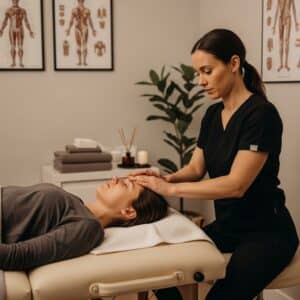
Craniosacral therapy (CST), often practiced within the broader domain of massage therapy and manual osteopathy, is a subtle, hands-on modality designed to assess and gently correct restrictions within the craniosacral system—comprising the membranes and cerebrospinal fluid that surround and protect the brain and spinal cord. Though often placed on the periphery of mainstream manual medicine, CST has gained a growing body of empirical and clinical interest due to its neurofascial and parasympathetic modulating effects. The objective of this article is to critically explore the theoretical basis, clinical applications, and emerging research surrounding craniosacral massage, with particular attention to its implications for trauma recovery, nervous system regulation, and somatic integration.
Historical and Theoretical Foundations
Craniosacral therapy was formally conceptualized by John E. Upledger, an osteopathic physician, during the 1970s, although its roots extend to the cranial osteopathy introduced by William Garner Sutherland in the early 20th century. Sutherland proposed that cranial sutures are not immobile, but rather allow for subtle rhythmic movements linked to a primary respiratory mechanism—a concept he described as “the breath of life” (Sutherland, 1939/1990). Upledger built upon this model by identifying what he termed the craniosacral rhythm, a palpable fluctuation of cerebrospinal fluid distinct from cardiac and respiratory rhythms (Upledger & Vredevoogd, 1983).
Although the idea of cranial bone mobility has been contested in traditional anatomy and neurology (Nelson et al., 2006), clinical evidence suggests that dural membrane tension and fascial restriction within the cranium and spinal canal may influence neurological function. CST practitioners typically use light touch—often no more than five grams of pressure—to evaluate and facilitate movement within this system, thereby improving central nervous system flow and reducing somatic dysfunction (Chaitow, 2005).
The fascia, a continuous connective tissue network, is integral to the craniosacral system. Fascia encases every muscle, bone, organ, and nerve, forming what Tom Myers refers to as “anatomy trains”—myofascial meridians that interconnect distant regions of the body (Myers, 2014). In this context, craniosacral massage may influence fascial structures far beyond the cranium, enabling systemic relaxation and postural recalibration.
Mechanisms of Action: Neurological and Biomechanical Insights
The proposed mechanisms of craniosacral therapy, while often described in energetic or non-specific language, have plausible anatomical and neurological substrates. At its core, CST is believed to affect the autonomic nervous system, particularly by facilitating parasympathetic dominance and vagal tone. Porges’ polyvagal theory provides a useful framework in this regard, highlighting the role of the vagus nerve in social engagement, safety, and homeostasis (Porges, 2011). Gentle manual therapy aimed at the cranial base, sacrum, or thoracic inlet may stimulate baroreceptors and mechanoreceptors that upregulate vagal activity and reduce sympathetic overdrive, contributing to a sense of calm and embodied awareness.
Additionally, the dural tube—spanning from the cranium to the sacrum—can develop torsions, adhesions, or restrictions due to injury, postural compensation, or psychological trauma. These restrictions may alter cerebrospinal fluid dynamics and place undue tension on nerve roots and vascular structures (Retzlaff et al., 1982). Through precise palpation and release of fascial holding patterns, CST may alleviate these strains and restore optimal neural flow.
Moreover, emerging research in interoception—the brain’s perception of internal bodily states—has underscored the importance of slow, mindful touch in modulating insular cortex activity and enhancing self-regulatory capacity (Mehling et al., 2012). Craniosacral massage, by virtue of its slow pace and non-invasive contact, may enhance body awareness, reduce somatic dissociation, and facilitate integration between cognitive and somatic processes, particularly in those with a history of trauma.
Trauma, Somatic Memory, and Clinical Implications
One of the most compelling applications of craniosacral therapy lies in its use for trauma recovery and somatic integration. Bessel van der Kolk’s work has emphasized that trauma is not only psychological but deeply somatic—stored in muscular tension, posture, breath patterns, and neurophysiological loops (van der Kolk, 2014). CST may act as a safe container for the gradual release of these patterns, often without the need for verbal processing.
Clinical reports frequently describe spontaneous emotional releases during craniosacral sessions, including tears, shifts in breathing, or subtle muscular tremors. Upledger referred to these phenomena as “somatoemotional release,” suggesting that tissues can hold unprocessed experiences until conditions are safe enough for expression (Upledger & Vredevoogd, 1983). While the term may lack empirical precision, it resonates with somatic psychotherapeutic paradigms such as those proposed by Peter Levine (2010), who argues that trauma recovery hinges on allowing the body to complete the defensive responses interrupted during the original event.
Craniosacral work may also complement psychotherapeutic efforts by regulating the client’s arousal level, enabling access to deeper emotional layers while remaining within the “window of tolerance”—a term introduced by Siegel (1999) to denote the optimal zone for emotional processing. This autonomic recalibration may help clients feel safe in their bodies, fostering what Levine calls “a felt sense of completion” (Levine, 2010).
Further, CST is increasingly used in pediatric populations, particularly for birth trauma, colic, and developmental challenges. Infants with plagiocephaly, torticollis, or breastfeeding difficulties have shown improvement after gentle craniosacral intervention (Arnadottir et al., 2020). These effects are likely mediated through both biomechanical adjustment and nervous system soothing, underscoring the non-invasive and adaptive nature of the technique.
Evidence Base and Research Limitations
Although CST remains controversial in some clinical circles, its research base is slowly expanding. Several randomized controlled trials and systematic reviews have investigated its efficacy for various conditions, including migraines, chronic neck pain, fibromyalgia, and anxiety. A 2012 study by Matarán-Peñarrocha et al. found significant improvements in pain and quality of life in fibromyalgia patients treated with CST compared to controls (Matarán-Peñarrocha et al., 2012). Another controlled trial published in Cephalalgia concluded that CST reduced the frequency and intensity of migraine episodes (Head et al., 2008).
Despite promising outcomes, the methodological rigor of many CST studies is limited. Common challenges include small sample sizes, lack of blinding, and subjective outcome measures. Moreover, the subtle nature of the intervention complicates placebo control. As Green et al. (1999) noted, “The light touch and quiet environment intrinsic to CST may themselves produce therapeutic effects independent of any specific mechanism.” This ambiguity complicates attribution of results solely to craniosacral mechanisms.
Nonetheless, qualitative studies have enriched the field by capturing patient experiences and the relational dimensions of touch. Clients frequently report feeling seen, grounded, or emotionally released—effects difficult to quantify but significant in terms of quality of life (Kern, 2005). These dimensions align CST with other touch-based therapies that prioritize therapeutic presence, attunement, and relational safety as mechanisms of healing.
Philosophical Underpinnings and Practitioner-Client Relationship
Craniosacral massage is not simply a technique; it embodies a philosophy of listening, non-invasiveness, and reverence for the body’s innate intelligence. Practitioners are trained to “follow” rather than “fix,” aligning with osteopathic principles that emphasize self-correction and structural harmony. Upledger often described the therapist’s hands as “instruments of listening,” cultivating a neutral presence rather than imposing force or intent (Upledger & Vredevoogd, 1983).
This orientation bears resemblance to certain contemplative practices and Eastern healing philosophies, which likewise stress the primacy of stillness, perception, and balance. In a world saturated with overstimulation, the slow tempo and quiet presence of CST may offer a counterbalance—an opportunity for the nervous system to downshift and recalibrate.
The therapeutic alliance plays a critical role here. Touch is not neutral; it is relational. Neuroscience affirms that interpersonal contact, when delivered with attunement and safety, can foster oxytocin release, reduce cortisol, and enhance affect regulation (Field, 2010). The quality of presence conveyed through CST may thus be as important as the technique itself, rendering it particularly effective for individuals who have experienced boundary violations or dissociation from the body.
Integration and Future Directions
Craniosacral massage is increasingly finding a place within integrative health models, often used alongside psychotherapy, acupuncture, physical therapy, and somatic movement. As trauma-informed care becomes the standard across disciplines, touch therapies that emphasize safety, nervous system regulation, and embodiment will likely gain relevance.
Future research would benefit from rigorous, interdisciplinary designs that combine physiological markers (e.g., heart rate variability, salivary cortisol) with subjective and qualitative data. It would also be useful to explore CST’s impact on neurodevelopmental conditions, autoimmune dysregulation, and functional somatic syndromes.
Despite skepticism in some clinical domains, craniosacral therapy continues to be practiced widely—precisely because it offers something many modalities do not: a profoundly quiet, subtle, and patient-centered invitation to come home to the body. In this sense, CST may be less about correction and more about permission—permission for the body to breathe, unwind, and remember what health feels like.
References
Arnadottir, M., Sigurdardottir, A., & Johannsdottir, K. R. (2020). The effect of craniosacral therapy on plagiocephaly in infants: A randomized controlled trial. Complementary Therapies in Clinical Practice, 39, 101121. https://doi.org/10.1016/j.ctcp.2020.101121
Chaitow, L. (2005). Cranial manipulation: Theory and practice (2nd ed.). Elsevier Health Sciences.
Field, T. (2010). Touch for socioemotional and physical well-being: A review. Developmental Review, 30(4), 367–383. https://doi.org/10.1016/j.dr.2011.01.001
Green, C., Martin, C. W., Bassett, K., & Kazanjian, A. (1999). A systematic review of craniosacral therapy: Biological plausibility, assessment reliability and clinical effectiveness. Complementary Therapies in Medicine, 7(4), 201–207. https://doi.org/10.1016/S0965-2299(99)80002-3
Head, K. A., Jäger, H., & Gross, R. (2008). Effectiveness of craniosacral therapy in the treatment of migraine: A randomized controlled trial. Cephalalgia, 28(9), 1030–1040. https://doi.org/10.1111/j.1468-2982.2008.01651.x
Kern, M. (2005). Wisdom in the body: The craniosacral approach to essential health. North Atlantic Books.
Levine, P. A. (2010). In an unspoken voice: How the body releases trauma and restores goodness. North Atlantic Books.
Matarán-Peñarrocha, G. A., Sánchez-Labraca, N., García-Rodríguez, M., Cañer, J. F., & Zafra, M. (2012). Effects of craniosacral therapy on pain and heart rate variability in fibromyalgia patients: A randomized controlled trial. Clinical Rehabilitation, 25(1), 25–35. https://doi.org/10.1177/0269215510375904
Mehling, W. E., Price, C., Daubenmier, J. J., Acree, M., Bartmess, E., & Stewart, A. (2012). The multidimensional assessment of interoceptive awareness (MAIA). PLOS ONE, 7(11), e48230. https://doi.org/10.1371/journal.pone.0048230
Myers, T. W. (2014). Anatomy trains: Myofascial meridians for manual and movement therapists (3rd ed.). Elsevier Health Sciences.
Nelson, K. E., Sergueef, N., & Glonek, T. (2006). Recording the rate of the cranial rhythmic impulse. Journal of the American Osteopathic Association, 106(6), 337–345.
Porges, S. W. (2011). The polyvagal theory: Neurophysiological foundations of emotions, attachment, communication, and self-regulation. W. W. Norton & Company.
Retzlaff, E. W., Mitchell, F. L., & Upledger, J. E. (1982). Physiological basis of craniosacral therapy. Journal of Manipulative and Physiological Therapeutics, 5(1), 19–26.
Siegel, D. J. (1999). The developing mind: How relationships and the brain interact to shape who we are. Guilford Press.
Sutherland, W. G. (1990). The cranial bowl (3rd ed.). Rudra Press. (Original work published 1939)
Upledger, J. E., & Vredevoogd, J. D. (1983). Craniosacral therapy. Eastland Press.
van der Kolk, B. (2014). The body keeps the score: Brain, mind, and body in the healing of trauma. Viking.